This is a useful tool for the test prep season.
http://www.catpin.com/bubbletest/
Friday, February 17, 2012


Tuesday, January 31, 2012
Text: "The Bear That Wasn't"
Included in Facing History's curriculum resources, this short story is useful for thinking about what forms our identity. We have used identity charts for both the bear and the student to help students start thinking about the influence of others' thoughts on our own identities.
Monday, March 21, 2011
An Educator's Guide to Twitter
I am newly intrigued by Twitter, slowly figuring it out, dipping my toes in, but not yet ready to jump. This is an excellent guide if your interested in getting started: An Educator's Guide to Twitter
WashPo Answer Sheet - The unusual next season of ‘Survivor’
Fantasy Revenge!
The unusual next season of ‘Survivor’: "Here is a dream write-up of the next season of the television show ‘Survivor’ that just about every public school teacher in the United States would love to watch."
The unusual next season of ‘Survivor’: "Here is a dream write-up of the next season of the television show ‘Survivor’ that just about every public school teacher in the United States would love to watch."
WashPo Answer Sheet - How test scores are used as a political prop
On the fact cherry-picking "reformers" and their continuing hypocrisy...
How test scores are used as a political prop: "Politicians have long used funding to mandate policy–often with little logic (consider the use of highway funds to force raising the drinking age to 21 under Ronald Reagan). This is happening with abandon in education, as policymakers ignore evidence as they insist on ‘reform.’"
How test scores are used as a political prop: "Politicians have long used funding to mandate policy–often with little logic (consider the use of highway funds to force raising the drinking age to 21 under Ronald Reagan). This is happening with abandon in education, as policymakers ignore evidence as they insist on ‘reform.’"
WashPo Answer Sheet - Ironic extremes: Lauding and bashing teachers
This will make you angry...
Ironic extremes: Lauding and bashing teachers: "How’s this for ironic extreme: An international conference is underway in New York about how to elevate the teaching profession, while, in Florida, a new law is about be put on the books that will go a long way to making sure nobody wants to be a public school teacher."
Ironic extremes: Lauding and bashing teachers: "How’s this for ironic extreme: An international conference is underway in New York about how to elevate the teaching profession, while, in Florida, a new law is about be put on the books that will go a long way to making sure nobody wants to be a public school teacher."
Wednesday, March 16, 2011
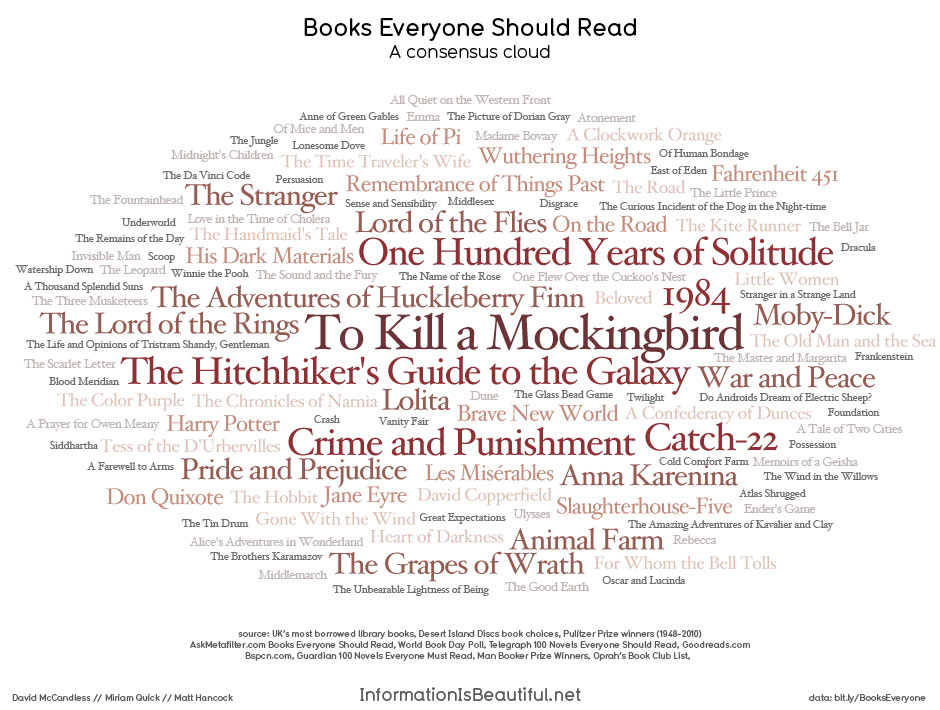
Ferlazzo: “The Books Everyone Must Read”
"The Guardian newspaper created a great word cloud infographic showing The Books Everyone Must Read. They used “the results of over 15 notable book polls, readers surveys and top 100’s.” It’s definitely worth a look…"
Tuesday, March 15, 2011
NCTE Inbox - Writing Conferences
A Look at Conferencing
For more ideas on conferencing in online environments, take a look at Preparing Educators for Online Writing Instruction: Principles and Processes. Beth Hewett and Christa Ehmann show how instructors can engage students in productive conversations about their writing with or without face-to-face contact. See also "Online Writing Instruction: No Longer a Novelty" from NCTE's Council Chronicle.
For more ideas on conferencing in online environments, take a look at Preparing Educators for Online Writing Instruction: Principles and Processes. Beth Hewett and Christa Ehmann show how instructors can engage students in productive conversations about their writing with or without face-to-face contact. See also "Online Writing Instruction: No Longer a Novelty" from NCTE's Council Chronicle.
The following resources from NCTE and ReadWriteThink.org provide more tips and strategies for conferencing with students.
The Council Chronicle article “Formative Assessment: Helping Students Grow” (G) shares how teachers can measure how well their students are learning by implementing and responding to class discussions, quick writes, reader response journals, quizzes, and writing conferences.
"Conferring in the Writing Workshop" (E), a themed issue of School Talk, highlights advice from four experienced teachers of writing -- Ralph Fletcher, Carl Anderson, Joanne Hindley Salch, and Marianne Marino. They share responses that can be given to student writers in the classroom which have been found to enable students to stretch their ability as writers.
Two teachers reflect on their combined experiences in teaching middle school, teaching preservice teachers, and teaching online in order to adapt and apply strategies for bringing positive experiences in a computer-based environment to middle grade students in the Voices from the Middle article, “Lessons Learned from Integrating Technology in a Writer’s Workshop” (M). The result is five valuable lessons, each of which is explained theoretically and described practically through a writers’ workshop example, where teachers conference with their students.
The approach to conferencing and feedback outlined in the Classroom Notes Plus article “Reworking Conferencing for More Effective Writing Feedback” (S) draws upon some basic structures that exist in most writing workshop classrooms at both high school and college levels. But a few important adaptations improve the effectiveness of teacher feedback and student uptake of that feedback.
Teaching students how to talk about their writing and responses to other students’ writing may be key in improving their writing skills. In “Thank You for Sharing: Developing Students’ Social Skills to Improve Peer Writing Conferences” (S) from English Journal, the author suggests several activities that can help. The examples here show how students can conference with each other.
NYTimes Op-Ed Contributor: Let Kids Rule the School
Let kids be in charce of their own learning and curriculum?
Op-Ed Contributor: Let Kids Rule the School: "Eight teens were given the chance to create their own curriculum, and the results have been transformative."
Op-Ed Contributor: Let Kids Rule the School: "Eight teens were given the chance to create their own curriculum, and the results have been transformative."
Monday, March 14, 2011
NYTimes: Essay: No Face, but Plants Like Life Too
Is it more "right" to kill and eat plants than it is to kill and eat animals? Essay: No Face, but Plants Like Life Too: "Vegetable behavior, and other ruminations on what we kill so we can eat. "
Subscribe to:
Posts (Atom)